Welcome @ec3.
I would like to formally nominate @ec3 as a member of this group, specifically the Narrative and Comms Subgroup. He has extensive experience in marketing and comms and would be a great value add to this group
4 Likes
Thank you @Sixty, we also both worked together every day for over a year at Push yeah.
3 Likes
Very cool! welcome to the Lazy Summer DAO forum @ec3, and thank you @Sixty for the nomination! Feel free to hit me up in DMs here with your Discord username (make sure to join here first).
Then @Raphael_Anode can add you into the Google Docs we have established for this working group. We use discord to coordinate so once added feel free to explore the groups, catch up with messages and I will be looking forward to your contributions!
4 Likes
@ec3 if you send me your email via DM here or on Discord I will add you straight away.
3 Likes
@jensei @Raphael_Anode I DM’d @Raphael_Anode the info. Thanks alL!
3 Likes
hey guys, any update here? We should have the final deliverables and onchain proposals by this date. Any reason why this is so delayed?
5 Likes
thank you @Javier for pointing it out, final touches are being adjusted to the checklist. The delay was caused by multiple factors, but I believe we should have a posting of the checklist (living document) brought up to the forum tomorrow (20/08/25) by @Raphael_Anode
4 Likes
SUMR LIQUIDITY PLAN v0.1
Mandate
- Secure $1M of TVL in vAMM_SMR/ETH
- Develop side pools such as vAMM_SMR/stbl to support volume.
- Harness relevant partnership and any other relevant tool (POL, fee structure, etc.) to minimize the cost of incentivization
Budget
| POL | Incentivization | |
| Launch Month | $135k pairing + SUMR eq | $45k SUMR/month |
| Following three months | // | $30k SUMR/month |
This liquidity plan uses $100k of stablecoin + $35k of ETH + $170k of SUMR from treasury for seeding/Protocol Owned Liquidity.
The cost of incentivization is ~$45k for the first month under very safe assumptions, with a high likelihood of being able to bring it down to ~$30k/month after.
Pairing Asset
- ETH is the main pairing asset.
- Stablecoins are secondary, with a preference for those with possible partnerships which have strong liquidity against USDC.
- Other pairings are not a priority.
Liquidity Structure
Considering this is a new token launch, with price discovery bound to happen, our choices of liquidity structure are constrained, as CL would be irresponsible at this stage: severely heightened volatility, high likelihood of out-of-range/thin liquidity area, etc. Before reaching CL, we need to build a sizable vAMM liquidity baseline, which this plan focuses on.
⇒ vAMM only for launch/around. A CL pool could be launched later to increase liquidity efficiency.
Fee Structure
We are optimizing for TVL in the pool, with a secondary mandate of cost reduction, therefore we can be more aggressive fee-wise, as the main downside of higher fees, lower volume and increased price impact are secondary concerns in our perspective.
- The main SUMR/ETH pool is set at 50 bps / 0.5% fee.
- Arbitrage/secondary pools set at 30 bps / 0.3% fee.
Protocol Owned Liquidity
The treasury controls $100k in stablecoins and $35k in ETH which can be used for seeding and POL:
- 50k in stablecoin to be swapped to ETH
- +35k existing ETH ⇒ $85k ETH + SUMR = $170k POL on the main pool
- 50k in stablecoin + SUMR = $100k POL on the secondary pool
Incentivization
Given the POL specified above, we can clarify our current projected status against the objective:
- $170k/$1M TVL in SUMR/ETH ⇒ we need to source at least $830k through incentivization
- $100k TVL in SUMR/stbl sidepool
Assumptions:
- SUMR token will be highly volatile around launch time
- The pool will be able to attract depositors as long as it is paying ~100%APY in the first month.
Calculation:
Total incentives for month 1: 100%/year => 8.33% of their principal in one month = $69139
Total Cost of Incentives for Month 1: 69139/1.5 (Safe Bribe Multiplier Assumption) = $46 092.66
⇒ ~$45k of SUMR is needed to confidently meet our objective month 1. Please keep in mind that a lot of assumptions are on the very cautious side of the spectrum, as for month 1, meeting the $1M TVL target promptly is absolute priority. The strategy can be refined in the following months as more data is available, especially regarding the LPs’ appetite for SUMR.
Collaborations
Several projects already manifested interested in collaborating with SUMR for liquidity:
OETH
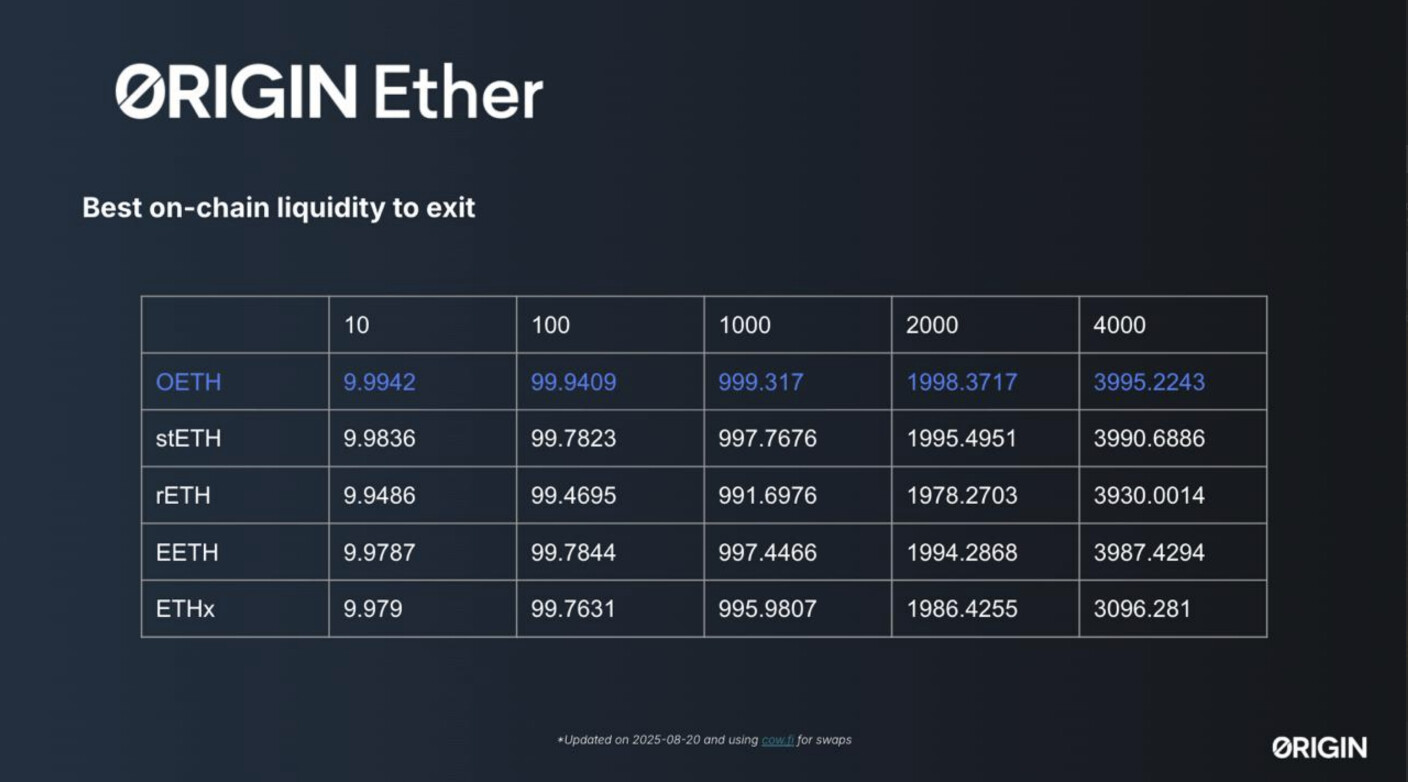
Pete from OETH, on the governance forum, offered a special type of collaboration with OETH, in the form of yield forwarding. OETH is a yield-bearing ETH LST. While OETH is deployed in a liquidity pool, OETH can enable Yield Forwarding, which redirects the underlying yield of the OETH in the pool, where we see fit: such as bribes for voters of the pool to reduce its costs of incentivization.
While this is of high interest for reducing cost of incentivization, it also comes with costs to consider: if SUMR/OETH is the main pool, pretty much every swap will have one extra step (+ associated 4bps fees), and the routing will worsen.
It is my opinion that strong liquidity should be built against a major and well routed token first, such as ETH or USDC.
BOLD
BOLD has a strong presence on Base with north of $5.5M of liquidity against USDC and other stablecoins. BOLD pools are supported by The DeFi Collective ~500k veAERO, as well as a share of the BOLD Protocol Incentivized Liquidity system, currently around 16% amounting for $3k of BOLD distributed to voters weekly.
The Collective is open to co-support BOLD-involving pools, and already doing so with BOTTO/BOLD, and POOL/BOLD. Was the community open to the endeavour, it could take several steps:
- Designating BOLD as the stable asset to pair with for the secondary pool ⇒ it will receive veAERO voting support from The DeFi Collective
- If further support is needed, The DeFi Collective also provides “permaLP” agreements, where, following a donation of SUMR, permanent liquidity is provided on the asset. Such agreements are ongoing with POOL and BOTTO.
Aerodrome
Whitelisting
This plan assumes SUMR capacity to obtain a whitelisting for Aerodrome rewards. Considering the project, this step should be a formality, but still shouldn’t be overlooked as it can impact the deployment schedule. The sooner the process is started, the better. The Aerodrome team will need the SUMR token address on Base to start the process, and will likely have further questions – a point of contact with good understanding of the SUMR contracts would be ideal to facilitate the exchanges. I can introduce and support the process.
Communications and Marketing
The marketing support the Aerodrome team is expected to provide to the SUMR launch was a key deciding factor. It can take the form of tweets, spaces, etc. I’ll let the person competent in that area input and lead in due time.
3 Likes
Thanks for including my idea for collaboration @TokenBrice!
These are valid concerns, although OETH is very strongly pegged to ETH and can handle millions in scale, especially compared to other LSTs:
3 Likes
I wanted to share a progress update on these key components, as they are foundational to enabling transferability and enhancing the overall governance system.
A core principle guiding this development has been simplicity over complexity. Our goal is to build an immutable and straightforward system that minimizes audit effort and is easy for the community to understand and verify. To that end, we are heavily reusing the battle-tested rewards contract model pioneered by Synthetix. This code is well-understood, has been audited countless times, and has secured billions in value, which significantly de-risks our implementation.
This simple foundation also gives us incredible flexibility for the future. By using a minter role on the new staked token, governance can approve additional contracts to mint xSUMR/sUMR down the line. This allows us to expand the ecosystem with new staking or incentive mechanisms without ever needing to alter the core, audited contracts.
Here’s a snapshot of where things stand:
Summer Governance V2
-
Status: 90% Done
-
Key Changes: We’ve completed the majority of the work on Gov V2. The most significant change is the removal of vote decay, simplifying the governance process. Other minor tweaks have been implemented.
Staked Summer Token (xSUMR / sUMR - Ticker TBA)
-
Status: 90% Done
-
Details: This will be the new governance and staking token. We’ve focused on a robust and simple implementation based on the OpenZeppelin standard for a mintable/burnable token with vote-enabling capabilities. Crucially, this version avoids complex on-chain vote accounting, which makes the system more secure, gas-efficient, and easier to audit.
New Staking Contracts
We are developing two primary contracts that will have minter roles for the new staked token.
1. Vesting Wallet Escrow Contract
-
Status: Ready
-
Mechanism: This contract allows users with vesting
SUMRto participate in governance. A user transfers ownership of their vesting wallet to this contract and, in return, receives the new staked token (xSUMR) at a 1:1 ratio based on the total tokens in their vesting schedule. This is a much cleaner approach than v1, as it’s a direct minting process without any complex balance manipulation.
2. Lockup Staking Contract
-
Status: 70% Done
-
Mechanism: This is our core staking contract for liquid
SUMRand comes with several features:-
Multiple Stakes: Users can create multiple, separate stakes with different lockup periods. Users can add to the stake or unstake (also partial) with penalty
-
Exponential Rewards Multiplier: Your staking weight (and thus your share of rewards) increases exponentially based on your chosen lockup duration, with a range from 0 to 4 years. Longer locks receive significantly more weight.
-
Withdrawal Penalty: If you need to withdraw before your lockup ends, there is a penalty. A key design choice here is that the penalty percentage is calculated based on the time remaining until your lockup ends, not the initial duration. For example, whether you initially locked for 4 years or 10 days, the penalty is the same if you have 5 days left on your term.
-
Tokenomics: You will receive the new staked token (
sUMR) 1:1 for everySUMRyou stake. -
Multiple Reward Tokens: The contract retains the v1 capability to distribute multiple different reward tokens, even though this feature wasn’t previously utilized.
-
Future-Proofing for Revenue Share: We are building this with revenue sharing in mind. A possible implementation could allow protocol revenue from the past week to be distributed to stakers over the following week. This would likely require a keeper-bot to automate the weekly distributions, avoiding the need for constant governance votes and ensuring a smooth process.
-
This work is intended to directly support the path to transferability by providing a clear, robust, and attractive staking and governance framework.
We welcome any feedback on these designs. Please let us know if anything is unclear or if you have questions about the mechanics, particularly regarding the lockup multiplier or the withdrawal penalty calculation. Your input now is invaluable as we finalize the last pieces.
5 Likes