Thanks to everyone who joined our third SUMR Transferability Community Call!
This session focused on final readiness for SUMR transferability, the rollout of Governance V2 + the new Staking & Lock Module (Staking V2), and a walkthrough of the new staking UI where we for the first time had a sneak peak into how users will migrate, stake, lock, and start earning dual rewards (SUMR + USDC from protocol revenue).
Below is a full recap of the call 
Context & Where We Are
We’re still on track for SUMR transferability, but with one small update to process.
- The Sherlock audit contest for Governance V2 & the Lock Module is nearly finished; no critical issues, final parameter reviews in progress.
- To avoid delaying deployment by another week, contributors proposed a combined governance vote that will:
- Add the Lazy Summer Foundation multisig as a temporary governor (to perform whitelisting)
- Allow the Foundation to whitelist the staking contracts immediately upon deployment, without waiting for a second vote.
[SIP]: [SIP5.13] Multi-chain Foundation Roles Setup
[TALLY]: Lazy Summer DAO (Official) | SIP5.13: Multi-Chain Foundation Roles Setup
Target for SUMR transferability remains: ~November 18 (pending DAO approval) with initial transferability launching on Base, with expansions to mainnet and other chains later.
As shared during the call:
“We are living up to the same timeline; governance stays in control, and we avoid unnecessary slippage.”
Staking V2 & How Locking & Rewards Will Work
On this call @samehueasyou demoed the new Staking & Lock module UI, where SUMR becomes productive governance.
Dual Rewards for Lockers:
- SUMR emissions (~5,000/day — proposal live on forum)
- USDC from protocol revenue (20% of protocol yield), distributed as LV (vault) tokens, which continue compounding automatically!
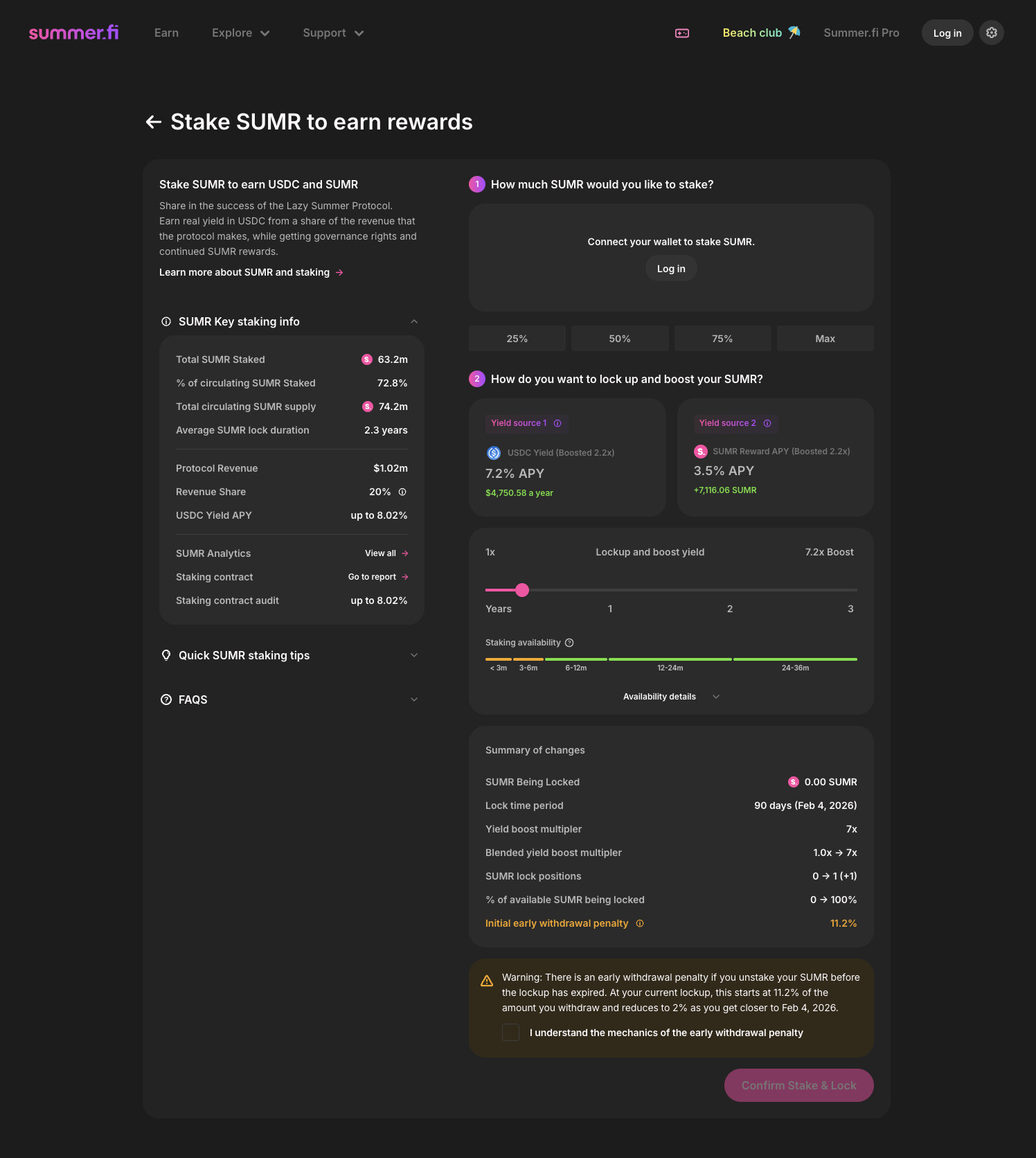
WIP for the Staking UI:

Locking Mechanics:
- Choose lock duration → receive a multiplier on voting power + yield
- Range: no lock (1x) → 3 years (~7.26x)
- Locks are non-extendable → plan ahead or use multiple lock positions (e.g. 3-year + 6-month split)
WIP for the Locking UI:

WIP for the All Locked SUMR UI:
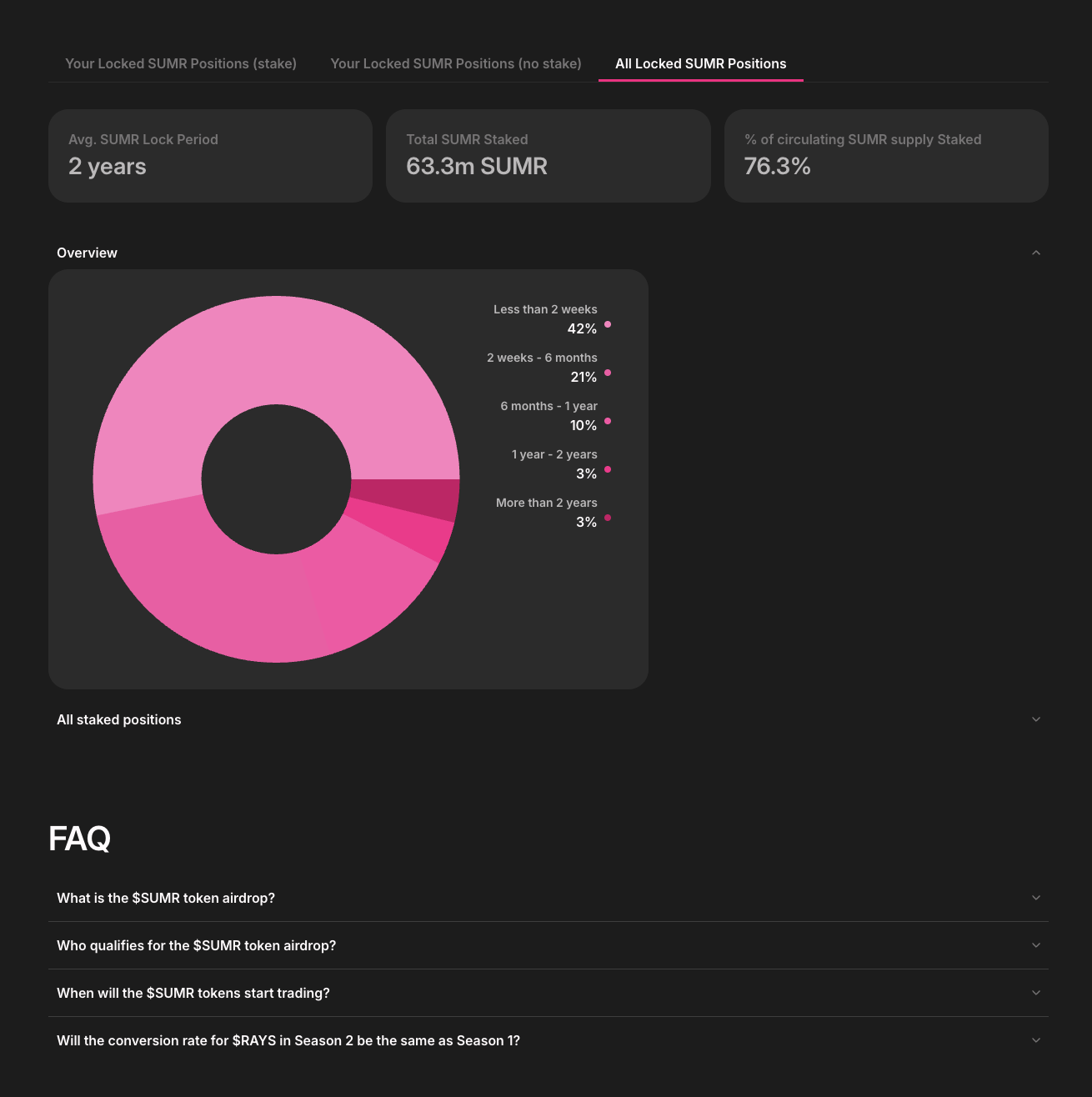
Capacity Limits (NEW):
Each lock duration has a maximum SUMR capacity.
- If a lock “bucket” is full → UI shows it as unavailable.
- Users can choose a shorter duration or lower the amount.
- Governance can vote to increase caps in the future.
As shared during the call:
“It’s conviction-weighted staking but with built-in scarcity.”
Rewards, Yield Loops & Transparency
The UI now helps users see how their lock contributes to long-term value.
Revenue → USDC to Lockers Flow:
More SUMR locked → stronger price → higher vault APY → higher TVL → more protocol revenue → more USDC rewards to lockers.
The UI shows:
- Expected USDC earnings.
- % of total SUMR supply locked.
- Average lock duration to gauge community conviction.
- Real-time available capacity per lock term.
This should add both transparency and social proof to governance participation.
Migration to Governance V2
Migration is manual (opt-in) as no one is forced. Users will be able to migrate on their own, directly via the new UI.
Migrating to V2 gives access to:
- SUMR daily emissions
- 20% USDC revenue sharing (as LV tokens)
- Full voting + delegation in the new governance system (xSUMR / sSUMR; naming to be finalized on forum)
Important:
- You cannot extend a lock duration after creating it
- Early withdrawals are possible anytime, but with a penalty (up to 20%, linearly decreasing over time), depending on the lock period.
Liquidity & Launch Strategy
- The Lazy Summer DAO treasury will bootstrap initial liquidity, likely SUMR paired with stable assets on Aerodrome (Base).
- Community LPs will be encouraged to join, expected to be incentivized with SUMR rewards & USDC via governance proposal.
- Full liquidity parameters (fees, gauges, emissions) will be posted to the forum before deployment.
- Transferability won’t be a “free-for-all”, it will be intentional, aligned with incentives and clear onboarding education.
How to Prepare
For existing SUMR holders:
- Decide your lock strategy, multiple durations if needed.
- Review Governance V2 migration process.
- Confirm your delegate, or plan to vote yourself.
- Be ready for the whitelisting + transferability vote.
For new users or Base newcomers:
- Bridge funds to Base.
- Keep some ETH for gas.
- Follow upcoming staking tutorials.
For LPs:
- Watch for the Aerodrome liquidity proposal on the forum.
- Review incentives and parameters before contributing.
Open Questions / Future Possibilities
| Topic | Status |
|---|---|
| Bonus for early lockers? | Not planned, lock capacity limits already create scarcity. |
| Governance power for LV (vault) token holders? | Not supported at launch, potential future discussion post-Gov V2. |
| Name for locked SUMR (xSUMR vs sSUMR)? | To be decided via forum proposal. |
Next Milestones
- Publish staking & locking tutorials
- Treasury plan for Aerodrome liquidity
- Governance vote to enable transferability
Expected SUMR transferability: around Nov 18th
Closing Thought
Every week brings us closer, so if you haven’t joined this time, keep an eye out for the next community call, soon.
Stay strong in these turbulent times, and get ready for the Summer to SUMR transition, with us!