Hey SummerFi community,
To assess the risks involved with Midas assets, we structure the analysis into two main parts:
- Assessing Midas as a tokenization infra
- Assessing specific mAsset and its underlying strategies
Midas platform
FULL MIDAS ASSESSMENT BY BA LABS
Midas Tokenization Platform - Risk Assessment by BA Labs
About Midas
Midas is a tokenization infrastructure providing access to structured yield strategies by introducing “Liquid Yield Tokens” acting as yield-bearing (non-rebasing) assets onchain (some examples: mTBILL, mMEV, mF-ONE, etc.). This includes tokenization of strategies acting as tokenized hedge funds, private credit products, carry trades, and more.
Current TVL of Midas protocol stands at ~$250m with 17 mToken offerings on their website as of now.
Issuance and Redemptions
Minting and redeeming of mAssets is a subject of each product, with tokens like mF-ONE having permissioned actions requiring Midas account for compliance and further verification (KYC/KYB), while others can have permissionless minting/redemptions.
Note: All wallets are required to agree with Midas platform’s Eligibility Requirements, Qualified Subordination, Risk Disclosures, and T&Cs.
Midas operates with 2 types of issuance and redemptions essentially depending on their duration.
Instant redemptions - While using instant redemptions, investors are able to redeem underlying instantly by providing Midas tokens. This action usually implies a redemption fee (depending on mAsset)
Standard redemptions - Similarly to instant redemptions possible on Midas UI, standard redemption process implies submitting a request transaction and waiting for the redemption to be processed by Midas, taking typically up to 2 days. After being processed, tokens are sent directly to the investor’s wallet. During the processing period, investors continue to benefit from potential price movements.
Redemption amount calculation is done by effectively liquidating mAssets based on a share of total amounts of tokens issued.
Atomic Redemptions
In an effort to provide a smoother redemption process, Midas has implemented redemption targets for each mAsset.
Live liquidity amounts available for redemptions can be checked on respective asset dashboard pages, and are subject to market and structural conditions.

Sharing below a full disclosure from official Midas docs regarding tokens issued by Midas:
Midas-issued tokens are structured as debt instruments. Investors have no legal or beneficial interest in the underlying assets and do not participate in their profits or losses. Claims are subordinated to the issuer under a qualified subordination agreement, ranking below all other creditors in insolvency but above shareholders. No payments may be demanded if they would trigger insolvency. Further details are available in the prospectus.
Fees
Midas platform charges management and/or performance fees on the mAsset level, alongside mint and redemption fees.
Note: Midas assets do not have any principal protection mechanism in place, meaning if the mAsset experiences devaluation, principal could be affected. Smaller haircuts are also possible, resulting in asset repricing on the market while staying above principal level, as seen with mF-ONE.
Audits
Midas has undergone numerous audits by firms like Sherlock and independent auditors, with a single high-impact finding related to storage layout incompatibility in audit reported at 30th of August 2025, addressed in later commits.
Find the full Midas-related audits list here.
BA Labs is commenting below on the two Midas vaults highlighted in the proposal above (mMEV & mApollo).
Midas mMEV
mMEV token is designed to track primarily delta-neutral DeFi crypto yields, managed by MEV Capital.
mMEV token holders are exposed to multi-chain stablecoin yield strategies, and are being charged 20% performance fees, and 0% management fees.
Backing
Current mMEV TVL stands at ~$23.5m.
As outlined in the Midas transparency dashboard for mMEV token, as of 2025-12-02 the majority of its current backing (>42%) is consisting of collateral composition mainly in Neutrl’s NUSD delta-neutral token.
Full collateral breakdown:
- $4.6m in Pendle PT-sUSDai and PT-USDai tokens
- ~$1.5m in Usual Boosted USDC & Smokehouse USDC Morpho vaults on Mainnet
- ~$10m in direct holdings of Neutrl’s NUSD
- $1.5m in Curve sUSDai/USDC LP
- 1% in thUSD
All funds reside in a single MPC wallet by “Fordefi” solution.

The remaining ~0.5% consists of redemption liquidity buffer (~0.5%) in this wallet, and liquidity that is yet to be deployed to strategies (~0.15%), sitting here. (Read more on the liquidity available for instant mMEV redemptions below).
Pendle & Curve USDai exposure
USDai contributes significantly to mMEV backing with 26%, with 75% of that being in form of Pendle PT tokens. Due to USDai’s risk profile, BA Labs highlights the significance of operational and counterparty risks of those types of assets (see NUSD collateralization section below for details).
Morpho vaults
MEV Capital USDC - The address backing the mMEV has a 5.2% share of deposits ($1.09m) in this USDC Morpho vault on Mainnet ($20.95m TVL). Here we’d bring attention to the Elixir’s deUSD depeg to which this vault had exposure, effectively experiencing a 3.6% loss by force-removing the sdeUSD/USDC market. The address labeled as a backing for mMEV was depositing USDC to this vault at the time.
As this vault represents 4.6% of mMEV backing, we note that its existing collateral distribution falls within the higher-risk scope of SummerFi, and should be treated as risky.
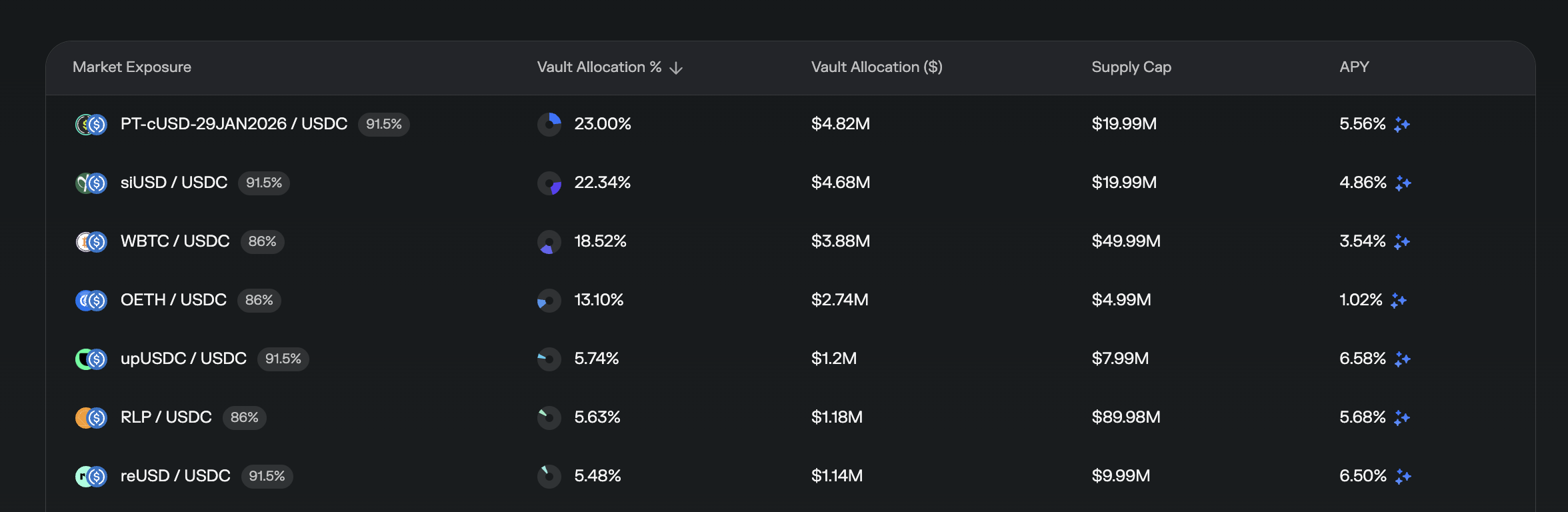
Smokehouse USDC - Smokehouse USDC vault is a high-yield vault curated by Stakehouse Financial, aiming to provide higher returns by doing further on the risk curve.
Notable vault exposure history includes recent mF-ONE haircut (2% downprint) due to Fasarna experiencing defaults in their loanbook, leaving vault lenders with no bad debt since thanks to buffers implemented by the curator.
Vault’s collateral breakdown falls in the higher-risk category wrt to SummerFi protocol, with significant exposures to Reservoir rUSD and Infinifi staked iUSD.
The address backing the mMEV has a 0.33% share of deposits (~$450k) in this USDC Morpho vault on Mainnet ($133m TVL), representing 2.2% of mMEV backing.
TL;DR: As significant portion of the mMEV consists of 10m of locked NUSD (standard NUSD locking) representing ~42% of mMEV backing, effectively locked till late May 2026 (unlock time: 2026-05-26), while the other portion of collateral also implies markets dependant on the secondary liquidity (not locked per se, but a subject of single AMM pool liquidity, as seen with Pendle AMM) we strongly suggest refraining from adding Midas mMEV token as collateral to SummerFi protocol as it could potentially result in reducing the available liquidity of SummerFi which is already at ~50% of the TVL, as stated at the end of assessment.
Please find the full risk assessment of Neutrl protocol below in Neutrl protocol overview section.
Concentration Risk
The number of holders of mMEV token at the moment of writing this report stands at 663, with a single address holding ~46% of the supply.

Redemptions
mMEV is a subject to layers of liquidity risks due to its structuring. First, there is the main redemption layer on Midas level, explained earlier.
Important: Atomic redemptions are not available for mMEV at the time of writing this (no instant liquidity available), resulting in a requirement to use the “Standard” redemption process requiring 1-3 business days to receive USDC back. We believe it’s rational to expect instant liquidity amount to depend mainly on the redemption process of underlying strategies, in this case USDai exposure unwind and Morpho vault’s available liqudity.
Note: As of now, we identified no relevant secondary markets nor liquidity for mMEV token on Mainnet including the RFQ quotes from private MMs, implying primary redemptions to be the core solution for potential withdrawals by SummerFi keepers.
Instant redemption fees for mMEV token are set to 0.5%
As of now, mMEV hasn’t experienced any haircuts / downturn price-wise since its deployment.
Neutrl protocol
Neutrl Protocol Overview
Neutral’s trading protocol uses stablecoins deposited into the system to generate yield through basis arbitrage, OTC carry, and on-chain reference yield pools (NUSD portfolio allocation).

- NUSD is a synthetic asset aiming keep market-neutrality and to follow the USD by tapping into new yield opportunites in OTC and altcoin markets. NUSD holders do not receive any yield (if not staked, nor locked).
- sNUSD is a staked version of NUSD token, representing a yield-bearing asset with yield reflected as price appreciation relative to the underlying (NUSD).
Collateralization of NUSD
Current supply of NUSD token stands at ~$158m, while ~20% of that is being staked in form of sNUSD.
All NUSD supply is minted on Ethereum Mainnet, with USDC, USDT, and USDe as eligible deposit tokens. Currently NUSD minting is via a permissionless process, while it can also be bought on the secondary markets.
NUSD token is overcollateralized by having 103.75% CR (153.8m NUSD supply with $159.6m in reserves), with over 72% of the reserves (~$115m) custodied via Fireblocks, while the remaining mostly sitting on CEXs like Bybit ($16.9m) and Binance ($14.6m).
We note that NUSD backing is verifiable via Accountable’s Data Verification Network (DVN), including independent proof of solvency. The dashboard allows anyone to verify that every NUSD in circulation is fully backed by verifiable assets by leveraging zero-knowledge attestations to confirm balances directly from custodians, exchanges, and smart contracts.

While we find it encouraging (being able to verify the collateralization, delta-neutrality, how funds are being managed, and not rely on self-reported data), we note that the risks related to counterparties, CEXs, ADLs, redemptions still persist in those types of assets and are significant.
Operational and counterparty risks being at the forefront, alongside ADL risks which have shown to potentially leave multiple projects running DN strategies on CEXs vulnerable due to unpredictable events like general uncertainty on the market resulting in MMs massively pulling their inventory out of precaution, leaving CEXs with no other option than to force-close open positions, potentially resulting in losses for some actors due to breaking the delta-neutrality of their strategies (e.g. by closing the short-side of the position(s)).
Furthermore, aside from the above-mentioned risks including operational, counterparty, CEX solvency, ADL, liquidity risks within strictly Neutrl’s domain of operation, used for yield generation at the moment, we emphasize the fact that collateral composition of mMEV asset is a subject to change with no timelocks put in place, potentially leading to a full risk profile change (in both directions) with the change of underlying strategies used for yield generation (e.g. addition of new collateral imposing new types of strategies, addition of new DN strategies, etc.), further increasing the risks due to this kind of uncertainty of its backing, as a yield token wrapper.
NUSD Locking (IMPORTANT)
To further increase the capital allocated to longer terms thus reducing the risks of forced selling, mainly referring to OTC deals, Neutrl allows for locking of deposits while offering higher returns.
Users can lock NUSD and/or sNUSD for 6, 9, or 12 months for boosted rewards and points.
As of 2025-12-05, ~$51m worth of NUSD is being locked. This includes the address stated in the backing of mMEV, representing ~20% of all NUSD locked.
The lock duration applied to this address is 201 days (unlock time: 2026-05-26), while 33 days have passed (16%). This indicates ~42% of all mMEV is locked till late May 2026.

NUSD Redemption
Redeeming NUSD is available only to approved KYB/KYC counterparties for backing assets (USDC, USDT, USDe) at a 1:1 USD value basis.
The protocol employs a dynamic liquidity management system through the AssetReserve contract. The AssetReserve maintains a dynamically calibrated liquid buffer designed to serve immediate redemption requests. When the requested redemption amount falls within the available buffer capacity, transactions are processed instantly with no delays.
Aside from instant redemption, for redemption requests exceeding the current liquid buffer, the protocol generates a redemption request and adds it to the processing queue aimed to be processed within 48h, with no guarantees.
Note: All the above is relevant to SummerFi only if SummerFi-related addresses are to be approved for redemption (KYC/KYB-ed).
As for secondary markets, the biggest pool is a Curve NUSD/USDC pool with $9.4m in TVL at the moment and almost perfect 50/50 token ratio, allowing for 4.5m of NUSD to be exchanged for USDC within 2% slippage window.
sNUSD Unstaking
We note that sNUSD has a 30-day unstake window during which stakers earn no rewards. The cooldown period ensures that there is enough time to unwind the collateral to meet the redemption.
Neutrl SC Risks
As for any DeFi protocol, Neutrl project is subject to smart contract risks. SC infra of Neutrl is a relatively new set of smart contracts responsible mainly for mint and redeem functions.
We note that NUSD codebase has undergone 4 different audits, all in 2025, done by Spearbit and Sherlock. No critical nor high severity issues were found.
Conclusion
To address all the above outlined risks, we propose refraining from listing Midas mMEV ARK to higher-risk USDC fleet on Mainnet mainly due to concerns related to illiquidity of mMEV identified at the current stage and market conditions. If/when the locking share of the mMEV asset backing lowers in the future, we’d be open to revise it.
Midas mApollo
Full mApollo assessment is to be provided subsequently in continuation of this forum thread.